Introduction
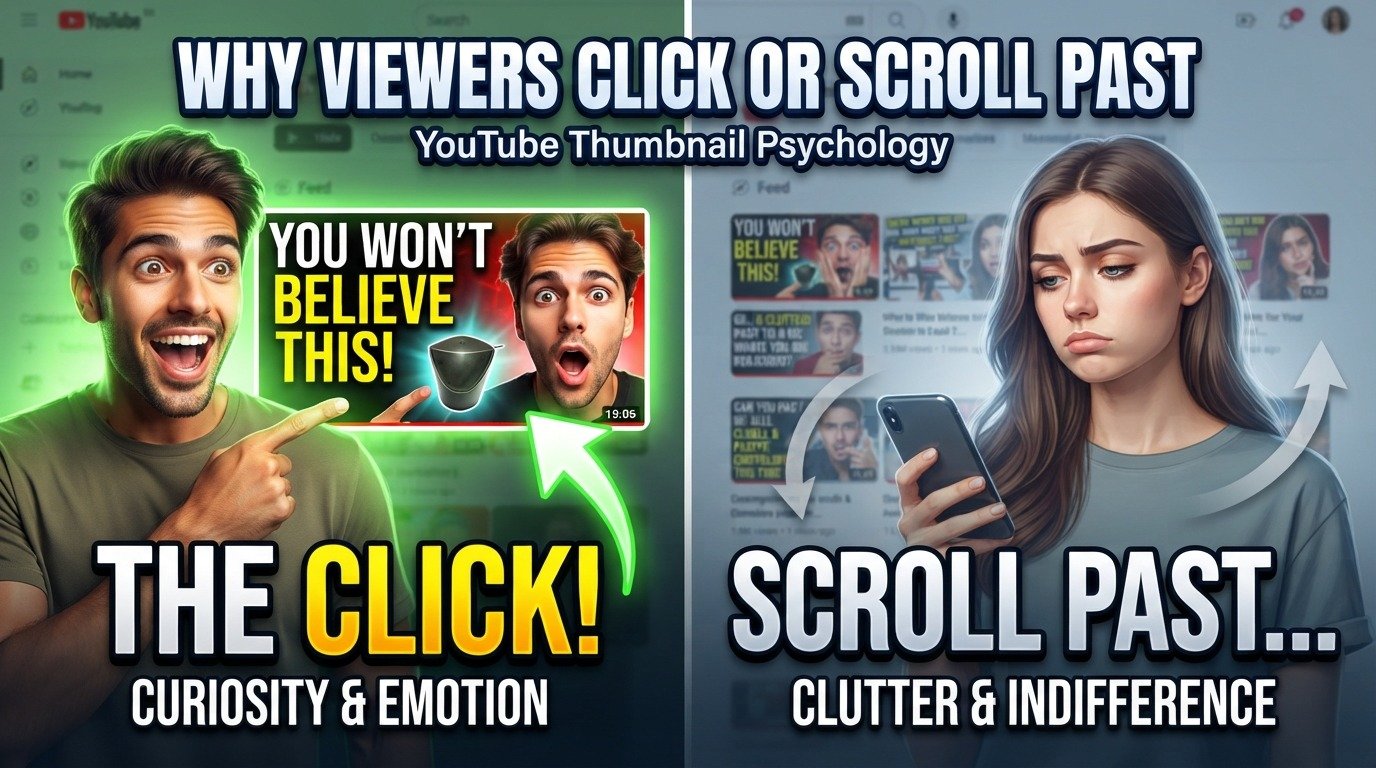
Have you ever wondered why some thumbnails make you stop scrolling instantly while others barely register in your peripheral vision? The answer lies in psychology, not design. Understanding YouTube thumbnail psychology is the difference between a video that gets 100 views and one that gets 100,000. Every day, millions of viewers make split-second decisions about what to watch. These decisions happen almost entirely outside conscious thought, driven by ancient brain wiring that responds to specific visual triggers. In this guide, I’ll break down the psychological principles behind YouTube thumbnail psychology and show you exactly what makes viewers click or scroll past.
The 1.5-Second Decision
Here’s a number that every creator should memorize: 1.5 seconds. That’s all the time your thumbnail has to stop a scrolling thumb. Not 5 seconds, not “long enough to read the title” — 1.5 seconds of raw visual processing. This is the foundation of YouTube thumbnail psychology. During that 1.5 seconds, the viewer’s brain makes a decision based almost entirely on instinct, not logic. The amygdala, the part of the brain responsible for emotional processing, activates before the prefrontal cortex, which handles rational thought. This means viewers feel something about your thumbnail before they think about it. Understanding this mechanism is what YouTube thumbnail psychology is all about.
The Curiosity Gap
One of the most powerful concepts in YouTube thumbnail psychology is the curiosity gap. The curiosity gap is the space between what your thumbnail shows and what it doesn’t explain. When viewers see a thumbnail that raises a question they can’t immediately answer, their brain experiences a form of cognitive discomfort. The only way to resolve this discomfort is to click. This is why thumbnails that promise answers work so well. “I Tried This For 30 Days” tells nothing and promises everything. “This Changed Everything” creates an immediate need to know what changed. “You’re Doing It Wrong” triggers a fear of missing out. These are all examples of YouTube thumbnail psychology at work.
The Role of Faces in YouTube Thumbnail Psychology
Facial expressions are arguably the most important element in YouTube thumbnail psychology. Human brains are wired to detect facial emotion in milliseconds — it’s ancient survival wiring that has been repurposed for content consumption. When the brain registers an intense emotion on another human face, it doesn’t ask permission to care. It automatically searches for the cause. This is why thumbnails with emotional faces consistently outperform those without. Wide eyes signal surprise and urgency. Visible teeth signal genuine emotion, whether it’s joy, shock, or anger. Direct eye contact creates a moment of connection that feels personal. YouTube thumbnail psychology teaches us that exaggerated expressions trigger a subconscious response before the viewer has consciously processed anything else on screen.
Color Psychology in Thumbnails
Color is another critical component of YouTube thumbnail psychology. Different colors trigger different emotional responses. Red signals excitement, urgency, and danger. Orange signals enthusiasm and energy. Yellow signals optimism and attention. Blue signals trust and professionalism. Green signals growth and calm. Purple signals creativity and luxury. Understanding color psychology helps you choose colors that match the emotional tone of your video. For example, if your video is about a life-changing hack, red or orange would be appropriate. If your video is about financial advice, blue would build trust. YouTube thumbnail psychology also emphasizes contrast — thumbnails need to stand out against YouTube’s dark mode background, so bright, saturated colors perform better than muted tones.
The Rule of 3 in YouTube Thumbnail Psychology
The Rule of 3 is a principle in YouTube thumbnail psychology that states: a face, a text hook, and one background object — that’s it. Every extra element you add doesn’t add value; it adds noise. Noise reads as cluttered chaos in a feed that’s already fighting for attention. The human brain can only process about three visual elements at once. When you add more, the brain becomes overwhelmed and scrolls past. This is why minimalist thumbnails often outperform busy ones. YouTube thumbnail psychology shows that simplicity is not a limitation — it’s a design skill that respects how the brain actually works.
The Pique Technique
One of the most effective strategies in YouTube thumbnail psychology is the pique technique. The pique technique involves presenting a surprising, unusual, or unexpected visual element that piques the viewer’s curiosity. For example, showing a person in an unusual location, holding a strange object, or making an unexpected expression. The pique technique works because the brain is wired to notice things that don’t fit the expected pattern. When viewers see something unexpected, their brain pauses to process it. That pause, even if it only lasts a fraction of a second, is enough to earn a click. YouTube thumbnail psychology shows that the unexpected is often more effective than the predictable.
Scarcity and Urgency
Scarcity and urgency are powerful psychological triggers in YouTube thumbnail psychology. When viewers believe they might miss out on something valuable, they are more likely to click immediately. Thumbnails that suggest “limited time,” “don’t miss,” or “only a few know this” create a sense of urgency. Scarcity works because humans are loss-averse — we fear losing something more than we desire gaining something. YouTube thumbnail psychology leverages this by making viewers feel that if they don’t click now, they’ll miss out on something important.
Social Proof in Thumbnails
Social proof is another psychological principle that applies to YouTube thumbnail psychology. When viewers see that a video has millions of views or that a respected creator is featured in the thumbnail, they are more likely to click. Social proof works because humans are social creatures who look to others for guidance in uncertain situations. YouTube thumbnail psychology uses social proof by featuring recognizable creators, including numbers in thumbnails, or showing reactions from others. The underlying message is: “Other people found this valuable, so you probably will too.”
The Status Quo Bias in YouTube Thumbnail Psychology
The status quo bias is the tendency for humans to prefer things to stay the same. In YouTube thumbnail psychology, this means viewers often default to the expected — the familiar — unless something forces them to reconsider. This is why predictable thumbnails fail. They blend in with everything else and get scrolled past without a second thought. YouTube thumbnail psychology shows that breaking the pattern — using unusual colors, unexpected compositions, or surprising elements — forces the brain to pause and reconsider the status quo. That pause is your opportunity to earn a click.
How to Study YouTube Thumbnail Psychology in Your Niche
Understanding YouTube thumbnail psychology is one thing; applying it to your niche is another. Here’s how to study what works in your specific category: Look at the top 10 channels in your niche and analyze their thumbnails. Pay attention to color usage, facial expressions, text placement, and overall composition. Notice patterns — do they use faces or avoid them? Do they use text or rely on imagery? Do they use bold colors or more professional tones? Once you’ve identified the patterns, test variations of your own. YouTube thumbnail psychology is not a one-size-fits-all formula — what works in gaming may not work in finance. The key is to understand the principles and adapt them to your specific audience.
Frequently Asked Questions (FAQ)
What is YouTube thumbnail psychology?
YouTube thumbnail psychology is the study of how visual elements in thumbnails trigger psychological responses that influence whether viewers click or scroll past.
Why do emotional faces work in YouTube thumbnail psychology?
Emotional faces trigger a subconscious response because human brains are wired to detect facial emotion quickly. This ancient survival mechanism makes emotional faces impossible to ignore.
What is the curiosity gap in YouTube thumbnail psychology?
The curiosity gap is the space between what your thumbnail shows and what it doesn’t explain. It creates a question that viewers need to click to answer.
How important is color in YouTube thumbnail psychology?
Color is essential. Different colors trigger different emotional responses. Contrast is also critical — thumbnails need to stand out against YouTube’s dark mode background.
What is the Rule of 3 in YouTube thumbnail psychology?
The Rule of 3 states that effective thumbnails should contain only three elements: a face, a text hook, and one background object. More elements create clutter and reduce performance.
What is the pique technique in YouTube thumbnail psychology?
The pique technique involves using surprising or unusual visual elements that force the brain to pause and process. That pause is often enough to earn a click.
Can I apply YouTube thumbnail psychology to other content?
Yes, the principles of YouTube thumbnail psychology apply to any visual content, including blog featured images, social media posts, and email newsletters.
Conclusion
YouTube thumbnail psychology is not about guessing what looks good. It’s about understanding how the human brain processes visual information and using that knowledge to earn clicks. The 1.5-second decision, the curiosity gap, emotional faces, color psychology, the Rule of 3, the pique technique, scarcity, social proof — these are not design tips. They are psychological triggers that have been studied and proven effective. The most successful creators don’t rely on intuition alone. They study YouTube thumbnail psychology, test variations, and let data guide their decisions. Start applying these principles today and watch your click-through rate improve.
Analyze thumbnails effectively now →
Have questions about YouTube thumbnail psychology?